- All
- Product Name
- Product Keyword
- Product Model
- Product Summary
- Product Description
- Multi Field Search
 EnglishEnglish

Views: 222 Author: Enoch Publish Time: 2026-05-28 Origin: Site


Choosing between a wood pergola and a metal pergola is no longer just a style decision – it's a long-term investment in comfort, maintenance, and property value. As a manufacturer with 27 years of pergola and garden room experience at Guangzhou Enoch, we see this choice play out every day in real projects across the US, Canada, Europe, and Central America. [azenco-outdoor]
This article will help homeowners, designers, and contractors decide which is better for their project: wood vs metal pergola, with a practical, expert-backed comparison across appearance, durability, cost, installation, and long-term ROI. You will also see where high‑quality PS (polystyrene) and aluminum‑frame systems fit in as a smarter alternative to traditional timber, especially for hot, humid, or coastal climates. [shadefx]
Use this table as a fast decision snapshot before diving into the details. [pergola-agava]
Factor | Wood Pergola | Metal Pergola (Aluminum / Steel) |
|---|---|---|
Visual style | Warm, natural, traditional look shadefx | Sleek, modern, architectural lines azenco-outdoor |
Durability | Can warp, crack, rot over time shadefx | Aluminum: highly durable; Steel: strong but can rust shadefx |
Maintenance | Regular staining, sealing, repairs shadefx | Aluminum: minimal; Steel: needs anti‑rust care shadefx |
Climate suitability | Sensitive in humid/coastal areas shadefx | Aluminum ideal near sea; steel needs protection shadefx |
Upfront cost | Usually cheaper materials shadefx | Higher materials, lower lifecycle cost shadefx |
Design flexibility | Custom carpentry, curves, rustic feel shadefx | Slim frames, motorized roofs, large spans azenco-outdoor |
Smart features | Mostly fixed‑roof, manual shade azenco-outdoor | Louvers, motorization, sensors, lighting azenco-outdoor |
Eco perception | Natural material, but often treated shadefx | Recyclable metals, long service life pergola-agava |
Wood pergolas remain popular because they feel warm, organic, and timeless. Many homeowners love how cedar or redwood weathers into a silver‑gray patina and blends into garden landscaping. Carpenters can shape wood into custom beam profiles, decorative cuts, and curved details that match traditional or farmhouse architecture. [shadefx]
From an industry perspective, wood works especially well when:
- The home already uses visible timber beams or rustic details
- The focus is on visual charm more than long‑term automation
- Budget is tight at the initial construction stage
Even with pressure treatment, wood is still an organic material that reacts to sun, moisture, and insects. Over time, beams can warp, twist, crack, or check, particularly in regions with strong UV or high humidity. Ground‑contact posts are especially prone to rot if not properly protected or isolated from soil and standing water. [shadefx]
In tropical or coastal climates – similar to Florida, the Caribbean, or Southeast Asia – termites and fungal decay can significantly shorten the lifespan of a wood pergola unless aggressive chemical treatments are used. [shadefx]
From a user‑experience standpoint, maintenance is where many wood‑pergola owners feel "buyer's remorse" after a few years. To keep a wood pergola looking sharp, you typically need to: [shadefx]
1. Inspect annually for cracks, rot, and loose fasteners
2. Re‑seal or re‑stain every few years, depending on climate [shadefx]
3. Treat or repair areas with insect damage or mold [shadefx]
These tasks mean ongoing labor and material costs and, importantly, downtime for the outdoor area. For hospitality projects (cafés, restaurants, hotels), that can translate directly into lost revenue when sections must be closed for refurbishment. [pergola-agava]
A wood pergola is still a good option when:
- The project is strongly style‑driven (cottage, farmhouse, or natural garden)
- The climate is mild and relatively dry
- The owner is comfortable with regular upkeep and likes the aged‑wood look
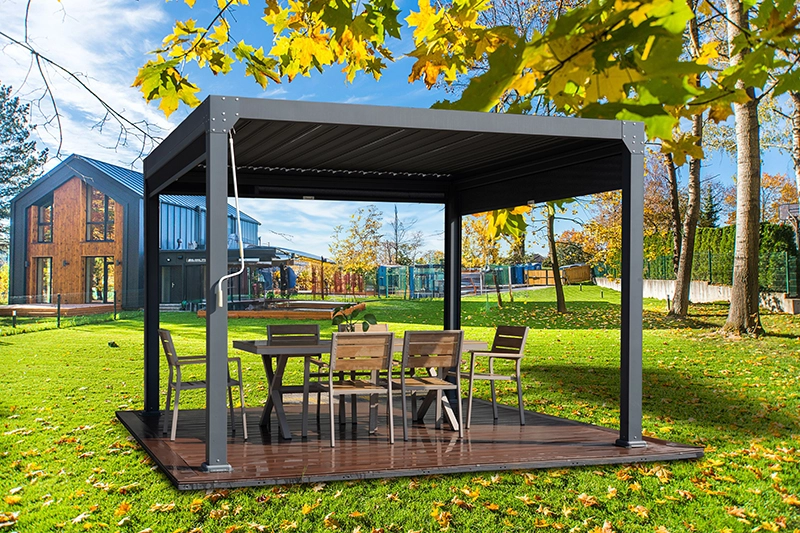
Metal pergolas – especially aluminum systems – define the modern outdoor living trend with clean, linear frames and slim profiles. In 2026, design trends highlight geometric lines, anthracite or deep carbon finishes, and combinations of metal frames with wood‑tone accents. This delivers a contemporary, almost "indoor‑outdoor room" feel that pairs well with large sliding doors and minimalist facades. [pergolapro.co]
Because aluminum profiles are engineered and extruded with high precision, they align perfectly, integrate hidden drainage, and support motorized louvers or retractable roofs without heavy bulk. [azenco-outdoor]
Metal pergolas split into two main categories: aluminum and steel/iron.
- Aluminum pergolas
- About 2.5 times lighter than comparable iron structures [pergola-agava]
- Do not rust and form a protective oxide layer [pergola-agava]
- Require very little maintenance beyond basic cleaning [pergola-agava]
- Steel / iron pergolas
- Extremely strong and suitable for very large spans or commercial structures [pergola-agava]
- Heavier and require coatings to prevent rust and corrosion [pergola-agava]
- Need periodic inspections and touch‑ups on coatings in exposed areas [pergola-agava]
Many coastal homeowners choose aluminum pergolas precisely because salt‑laden air accelerates steel corrosion and wood decay, while aluminum maintains its structure and finish for years when properly coated. [shadefx]
The main advantage metal pergolas – especially aluminum – have over wood is that they are close to maintenance‑free. They do not splinter, sag, or twist, and quality powder‑coated finishes resist fading and peeling for many seasons. Most of the maintenance reduces to simple steps: [azenco-outdoor]
- Occasional rinsing with water and mild soap
- Visual checks on moving parts if the roof is motorized [azenco-outdoor]
- Very rare re‑coating if the pergola is in an extreme environment
In lifecycle terms, this translates to fewer service calls, lower total cost of ownership, and more uninterrupted enjoyment for the end user. [azenco-outdoor]
A traditional wood pergola is typically a fixed‑roof structure – either a solid roof or fixed open slats. That means shade and rain protection are not easily adjustable without additional awnings or fabric systems. [azenco-outdoor]
Modern metal pergolas, by contrast, can integrate: [pergolapro.co]
- Motorized louvered roofs that open and close on demand
- Rain and wind sensors for automatic protection
- Built‑in LED lighting and side screens
- Hidden gutters and drainage to keep the space dry
This transforms the pergola from a static structure into a multi‑season outdoor room, which is especially valuable for hotels, restaurants, and homeowners who entertain frequently. [sunjoyshop.co]
Pressure‑treated wood pergolas are usually less expensive in terms of raw material costs than metal pergolas. Cedar or redwood move the price upward but still often start lower than fully engineered aluminum systems. [shadefx]
Metal pergolas, particularly high‑end aluminum with automation, come with a higher upfront ticket because of:
- Precision‑engineered profiles
- Powder‑coating systems
- Motorization and drainage engineering [pergolapro.co]
When you factor in maintenance, repair, and replacement, the cost picture often flips in favor of metal: [azenco-outdoor]
- Wood may require sanding, staining, sealing, insect treatments, and periodic repairs throughout its life. [shadefx]
- Improperly maintained structures might need partial or complete replacement much earlier than expected. [shadefx]
- Aluminum pergolas can operate for many years with minimal intervention, especially in harsh climates. [pergola-agava]
For commercial projects, consistent guest experience, fewer closures, and a premium aesthetic can easily justify the higher initial capex of a well‑specified metal system. [pergolapro.co]

Choosing between wood vs metal pergola is heavily influenced by local climate and site conditions. [pergola-agava]
- Humid / tropical climates
- Wood faces higher risks of rot, mold, and insect attack. [shadefx]
- Aluminum or well‑protected steel is usually more reliable. [pergola-agava]
- Coastal / seaside locations
- Salt accelerates corrosion in untreated steel and deteriorates many wood finishes. [shadefx]
- Aluminum with marine‑grade coatings performs significantly better. [pergola-agava]
- Dry, temperate regions
- Both wood and metal can work well.
- The decision leans more toward style, budget, and desired maintenance level. [shadefx]
From Guangzhou Enoch's project experience, customers in North America and Europe increasingly specify aluminum or metal‑frame pergolas with PS decorative elements for coastal and high‑UV locations to balance durability, thermal comfort, and stable appearance. [progolas]
Homeowners typically prioritize comfort, aesthetics, and low hassle. [azenco-outdoor]
- A wood pergola works for clients who:
- Love a natural, organic look
- Enjoy DIY care and seasonal upgrades
- Live in milder, less humid climates
- A metal (especially aluminum) pergola fits those who:
- Prefer a clean, contemporary style
- Want motorized shade and all‑weather use
- Live close to the sea or in harsh climates
Restaurants, cafés, hotels, and event venues require predictable performance and uptime. In our B2B projects, metal pergolas dominate because: [pergolapro.co]
- Larger spans and higher wind loads are easier to achieve with engineered metal systems. [pergola-agava]
- They support retractable roofs, lighting, and side screens for all‑day use. [pergolapro.co]
- Maintenance can be planned into scheduled building services rather than constant reactive repair. [pergola-agava]
While the classic debate focuses on wood vs metal pergola, many advanced manufacturers now deliver hybrid systems that combine metal frames with PS or composite decorative elements to preserve the look of wood while eliminating its weaknesses. [chinese.alibaba]
From an expert manufacturing perspective, these systems can offer:
- Metal or aluminum structural frames for strength and stability [progolas]
- PS or composite "wood‑look" slats and beams that resist rot and insects
- Consistent color and grain without annual refinishing
This is especially valuable for customers who want a wood‑like appearance above eye level (rafters, slats) but need metal performance for posts and primary beams. As a result, many 2026 pergola trend reports highlight mixed materials: metal frames with natural‑tone accents. [capeandco]
If you are still unsure, use this simple, expert‑level framework to pick between wood and metal:
1. Clarify the main goal
- Pure aesthetics and rustic charm? Wood or hybrid system.
- Modern, low‑maintenance outdoor room? Metal (aluminum) pergola.
2. Assess your climate and location
- High humidity, intense sun, or near the sea? Prioritize aluminum. [shadefx]
- Mild, dry climate? Either material is feasible.
3. Define your maintenance tolerance
- Enjoy DIY projects and seasonal work? Wood is acceptable.
- Want "set it and forget it"? Choose metal. [azenco-outdoor]
4. Evaluate desired functionality
- Fixed shade is enough? Wood or simple metal frame. [azenco-outdoor]
- Need adjustable shade, rain protection, and lighting? Motorized metal. [pergolapro.co]
5. Plan for total lifecycle cost, not just day‑one price
- Calculate finishing, repair, and likely replacement timelines. [shadefx]
- For rentals or hospitality, prioritize uptime and brand perception. [pergola-agava]
As a pergola and garden room specialist with decades of manufacturing and export experience, Guangzhou Enoch focuses on engineered outdoor structures that balance aesthetics, structural reliability, and user comfort. For overseas clients in the US, Canada, Europe, and Central America, we typically recommend: [progolas]
- Aluminum or metal‑frame pergolas for coastal, commercial, or high‑use applications [azenco-outdoor]
- Wood‑look PS or composite accents when the design calls for warmth without accepting the maintenance burden of real timber [chinese.alibaba]
By combining in‑house R&D, customized engineering, and global project feedback, we help partners choose not just "wood vs metal," but the correct system specification for their climate, brand, and business model. [progolas]
If you care most about traditional charm and natural materials, a wood pergola can still be the right choice – provided you are prepared for regular maintenance and accept a shorter effective lifespan in harsh climates. If you prioritize durability, low maintenance, and modern functionality, an aluminum or metal pergola is usually the better long‑term investment, especially when you want motorized shade and all‑weather usability. [azenco-outdoor]
For many of our global clients, the best solution today is not a strict either/or, but a hybrid approach: metal structural frames with wood‑look composite or PS details that deliver warm aesthetics and robust performance at the same time. [chinese.alibaba]
If you are planning a pergola or garden room project and still weighing wood vs metal, share your climate, project type, and preferred style with Guangzhou Enoch. Our engineering team can propose a tailored configuration – from frame material and roof system to finishes and accessories – that maximizes comfort, durability, and return on investment for your specific site. [progolas]
1. Which lasts longer, a wood pergola or metal pergola?
A well‑designed aluminum pergola typically outlasts wood because it does not rot, warp, or attract insects, and is highly resistant to corrosion when properly coated. [pergola-agava]
2. Are metal pergolas too hot in summer?
With good design – including louvered roofs, proper ventilation, and light‑reflective finishes – aluminum pergolas can stay comfortable, especially when combined with fabric shading or side screens. Wood feels cooler to the touch, but the overall heat experience depends more on shade design than material alone. [pergolapro.co]
3. Is a wood pergola cheaper than a metal pergola?
Upfront, pressure‑treated wood usually costs less than engineered aluminum systems. Over time, however, repeated staining, sealing, and repairs can make wood more expensive than low‑maintenance metal solutions. [azenco-outdoor]
4. Which is better near the ocean – wood or metal?
Near the ocean, aluminum pergolas with high‑quality coatings are generally preferred because they resist rust and handle salty air better than wood and unprotected steel. Wood finishes degrade faster in harsh coastal conditions unless constantly maintained. [shadefx]
5. Can I get a pergola that looks like wood but performs like metal?
Yes. Many modern systems use aluminum frames with PS or composite cladding and slats that replicate wood grain and color while avoiding rot, insects, and frequent refinishing. This hybrid approach is increasingly popular in 2026 outdoor living designs. [capeandco]
- Azenco Outdoor – "Metal or Wood Pergola, Which is Better?" [Link] [azenco-outdoor]
- ShadeFX – "Wood or Metal Pergola: Which One is Right for You?" [Link] [shadefx]
- Pergola Agava – "Metal and iron pergola advantages and differences" [Link] [pergola-agava]
- PergolaPro – "Pergola Trends 2026 – The Ultimate Guide to Modern Outdoor Living in New Zealand" [Link] [pergolapro.co]
- Cape & Co – "21 Modern Pergola Ideas for 2026: Creating Your Social Sanctuary" [Link] [capeandco]
- Sunjoy UK – "Top Pergola Trends in the UK for 2026" [Link] [sunjoyshop.co]
- Progola – "Aluminum Pergola Manufacturers | Made In China" [Link] [progolas]
- Alibaba – Example hybrid aluminum pergola with composite/PS components [Link] [chinese.alibaba]
